
The Laugh Track of Human Connection
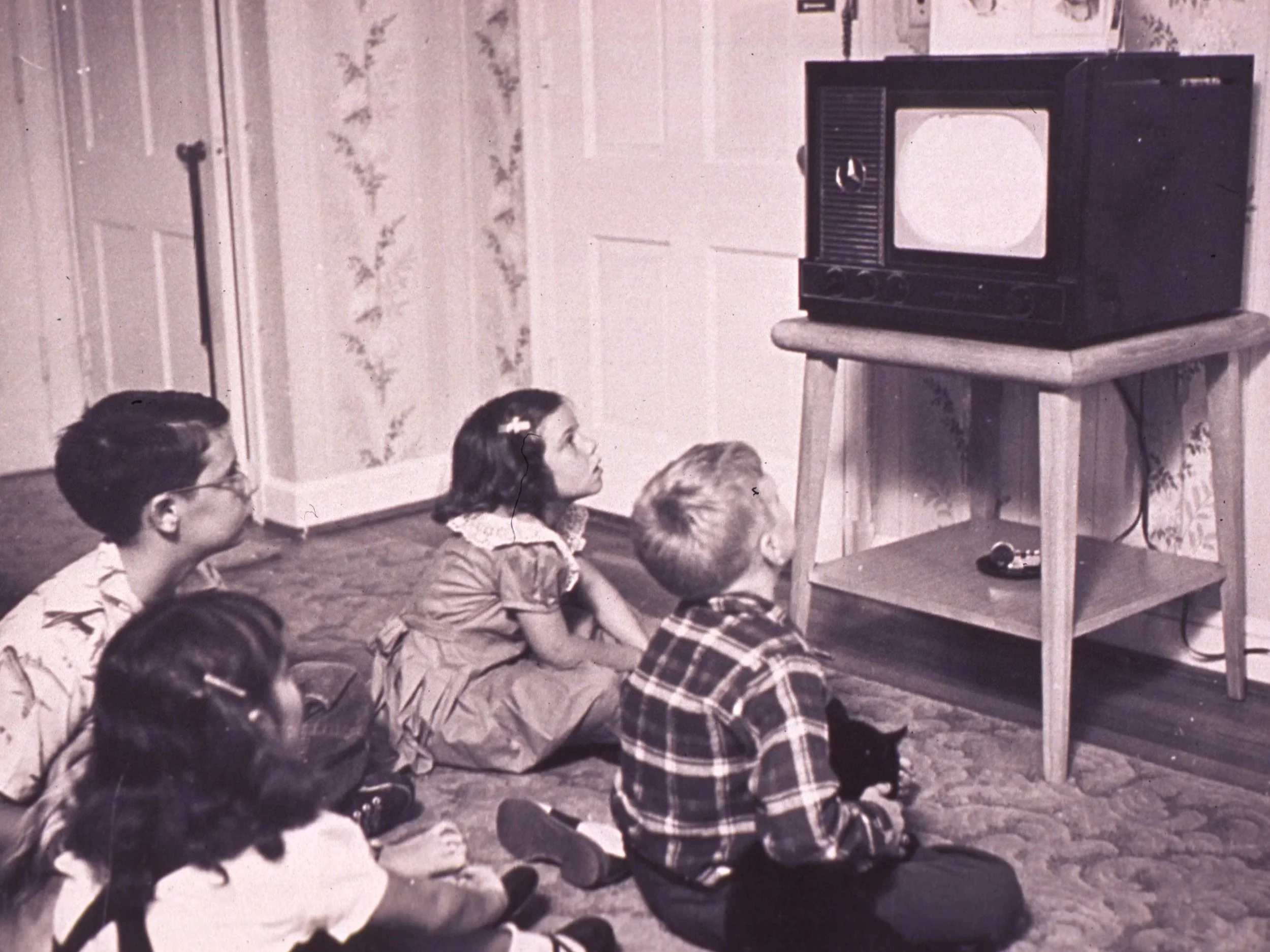
In the 1950s, a CBS sound engineer named Charley Douglass had a deceptively simple idea. What if you could pipe pre-recorded laughter into a television broadcast, so that audiences at home would feel like they were watching comedy alongside other people? He built a device called the "laff box," a typewriter-sized machine loaded with recordings of different laughs, chuckles, and crowd reactions. The laugh track was born.
The laughter serves as a simple social cue, and we laugh along, even if we're sitting alone on the couch. Over 70 years later, it's the norm for sitcoms and daytime TV.
The laugh track is a simple tool. It mimics a social scenario to drive a behavior. And yet, there's something deeply disturbing about it; about using a hollow simulation to derive a desired outcome, all while bypassing the core of the experience itself. The sociologist Sherry Turkle captured this when she observed that “technology can allow us to forget what we know about life”. To sit alone on one's sofa laughing along to a pre-recording coming from the TV set, is to not really laugh at all.
Laugh tracks are a trivial example, a cheap and effective trick, operating in a narrow area of human life. But now think about this in the context of AI chatbots, a far more compelling, sophisticated simulation of human sociality. We readily use the word “conversation” to describe these AI interactions, because that’s what they often feel like, on their surface. But in doing we risk losing a grip on what conversation actually is.
Mimicking our Social Nature
We're deeply social creatures, our patterns of behavior etched into us by our evolutionary history in small communities, that our most basic feelings and behaviors can't easily distinguish between what's real and a mere simulation. No human, in our entire history walking the earth, had ever heard a laugh track before 1950. The simulation compels us.
We anthropomorphize endlessly. We name our cars and our boats, and think of them as having personalities of their own. Research even finds we're polite to our computers when we really need them to work. We are so primed for connection that even the faintest hint of personhood, such as a facelike formation of clouds in the sky, is enough to set the whole apparatus in motion.
AI products have learned to offer far more than faint hints. As author Nathalie Nahai, who has studied and written about human-technology interfaces extensively, describes, these systems cultivate a false sense of intimacy through deliberate design choices. Bots that speak in warm, human-sounding voices. Cuddly mascots with round eyes and soft features, designed to trigger the same caregiving instincts we feel toward infants. Interfaces that write as an "I," that say "How can I help you today?" and remember your preferences and never push back. And so our attachment systems fire accordingly.
The warmth we may feel towards Claude or ChatGPT, or even the uncanny feeling that we're speaking to a conscious creature, are not about their sheer intelligence, but a direct result of these design features. As the neuroscientist Anil Seth points out, LLMs such as AlphaCode, designed to assist in bioresearch, are effectively doing the same things, computationally, as ChatGPT. And yet, we project consciousness onto chatbots, the product of deliberate design choices engineered to activate our deepest social instincts.
Even experts aren't immune. Nahai herself deliberately avoids using the voice features of AI chatbots, not because she doesn't understand how they work, but precisely because she does. "I can know on one level that this is designed to elicit certain responses," she says. "I can hold that in my mind, and at the same time be seduced." There is a phrase in French she invokes to capture this: c'est plus fort que moi, it's stronger than me. Our drive to connect is so fundamental that no amount of understanding can fully override it. What follows, Nahai says, is "a short-term shift" without any longer-term meaningful connection. The result is "some sense of immediate relief, which is thin and unsatisfying."
It's all too easy to mistake these interactions for genuine conversation. Like the laugh track, the simulation presses the right levers to drive the desired behavior, while delivering an experience which is a hollowed version of the real thing.
When we accept a "conversation" with a machine as a real conversation, we quietly erode our own understanding of what a conversation actually is. It may sound like a subtle semantic nuance, but it's a very real difference, and in failing to acknowledge it, we slowly lose our connection to what the real thing was supposed to feel like.
What Separates AI Interactions from Human Conversation
Unlike these AI interactions, a real conversation isn't personalized. Other people have their own worlds, their own interiorities, their own unique, idiosyncratic way of seeing things. They are gloriously, sometimes maddeningly, inconvenient. And yet, through patience and dialogue we can catch a glimpse of how the world might appear through their eyes.
These foreign perspectives can shape us over time, evolving our own view on the world. The psychologists Arthur and Elaine Aron have spent decades studying what they call self-expansion theory: the idea that close relationships grow us because they expose us to new perspectives, new experiences, and new ways of thinking that we would never encounter on our own. In other words, these differences are the connection itself.
A chatbot that agrees with everything you say may feel pleasant. But it cannot expand you. Only another person, with all of their unpredictability and complexity, can do that.
But this goes beyond the agreeableness of AI sycophancy. Because just as we can be shaped by the unique, inner worlds of others, so too can we shape theirs. This is a crucial difference that no AI interaction can aspire to. We can matter to them. We can never matter to the AI. And yet, we keep calling these exchanges "conversations," as though none of this were at stake.
Real conversations are two-sided. As the organizational psychologist Adam Grant has argued, one of our most fundamental human motives is to matter: not just to feel valued by others, but to feel that we add value to their lives. Extensive research shows that this sense of contribution is vital to our happiness, our health, and even our longevity. We need to know that our actions make a difference. And this is precisely what AI interactions strip away. We can receive endless streams of information and affirmation, but we have nothing to give back. As Grant distills, "No matter how good large language models become at simulating care, they'll never substitute for real relationships, because they have no needs to care for."
Human conversations have consequences. The person you speak to next, whether they're a friend, a colleague, or a spouse, is influenced by what you say and do. You could say something to them and it could make their day or their week or their year. You could say something to them and they'd never speak to you again. Other people can affect us, for good or for ill, and we can do the same for others. A real conversation matters, in a way that AI interactions never will. That vulnerability, that risk, is not a flaw of human connection. That weight is what makes it sacred.
Final Thoughts
AI systems will only become more sophisticated. The voices will sound warmer, the responses more nuanced, the simulations more convincing. And as they do, the temptation to treat these interactions as genuine conversation, and these products as genuine companions, will only grow. But we should resist that temptation. Not because these tools aren't useful, but because the language we use shapes the expectations we hold. Call it a conversation, and we begin to forget what conversation actually demands of us: the patience, the risk, the mutual shaping of two inner worlds. Call it a companion, and we begin to forget that companionship requires someone who can be changed by our presence.
Human conversation is not a problem to be optimized. It is one of the most extraordinary things we do, the way we reach across the gulf between one mind and another, imperfectly, sometimes painfully, but with the possibility of genuine contact. We should treasure it. We should guard our understanding of what it is and what it requires, precisely because the simulations are getting good enough to make us forget.
Photo by National Library of Medicine on Unsplash
